Why LGBTQ+ travelers don’t trust “gay-friendly” anymore
There was a time when a rainbow flag at reception felt like a signal.
Today, it’s almost meaningless.
Not because inclusion no longer matters — quite the opposite — but because LGBTQ+ travelers have become far more experienced, and far more perceptive. They travel often, compare constantly, and notice everything. The tone at check-in. The way a booking is handled. The subtle hesitation — or the complete absence of it — when two men or two women walk in together.
What used to be reassuring has become superficial.
And over time, a new instinct has emerged: the ability to tell, almost immediately, whether a hotel truly understands you — or is simply trying to look like it does.
That distinction is now at the heart of the travel experience.
The brands that quietly set the standard
Some hotel groups adapted. Others anticipated. A few, more rare, never needed to adjust because inclusion was already part of their DNA.
These are the brands that don’t just welcome LGBTQ+ travelers — they create environments where being yourself requires no effort at all.
Kimpton: the brand that never had to catch up
Long before diversity became a corporate topic, Kimpton Hotels & Restaurants had already made it part of its identity.
In the 80s and 90s, when much of the hospitality industry was still cautious, the brand was openly supporting LGBTQ+ communities, welcoming same-sex couples without question, and extending equal benefits to its employees. It wasn’t positioning. It was culture.
That legacy is still visible today, but not in obvious ways.
It’s in the atmosphere. In the tone. In the absence of friction.
Even something as simple as the evening wine hour takes on a different meaning here. What looks like a casual perk becomes a social space where people connect naturally — solo travelers, couples, locals — without labels, without effort.
You don’t feel included. You feel at ease.
Marriott: making inclusion scalable
With Marriott International, inclusion operates at a completely different scale.
What could have remained a corporate message has been turned into something operational, measurable, and — most importantly — consistent.
For years, the group has worked closely with the Human Rights Campaign, maintaining top scores on equality benchmarks while rolling out global training programs across its properties.
But what matters is not the score. It’s what happens when you arrive.
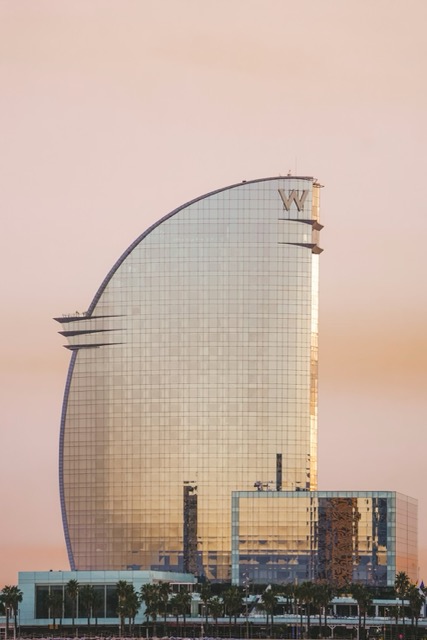
From a W in Barcelona to an Edition in New York, there is a continuity in experience. No hesitation. No assumptions. No need to explain anything.
Marriott may feel structured.
But for many LGBTQ+ travelers, that structure translates into something invaluable: peace of mind.
Hilton: the quiet strength of consistency
Hilton rarely tries to be the loudest voice in the room.
And yet, its commitment to LGBTQ+ inclusion is one of the most consistent in the industry.
Over the years, Hilton has built long-term partnerships with organizations such as the International LGBTQ+ Travel Association and the Matthew Shepard Foundation, while maintaining a perfect score with the Human Rights Campaign.
It was also one of the first major hotel groups to directly address LGBTQ+ travelers in its campaigns, as early as 2012.
But none of that is what you notice first.
What you notice is the absence of friction. The normality of the interaction. The feeling that nothing about your presence is unusual.
Hilton doesn’t create a statement. It creates trust.
Accor: inclusion as a responsibility, not a trend
Accor approaches inclusion with a different mindset — one that feels distinctly European.
Less expressive, perhaps, but often more structural.
Through its partnership with the International LGBTQ+ Travel Association, Accor has positioned itself as an active contributor to the evolution of LGBTQ+ travel, rather than a simple participant.
The group openly acknowledges a reality that many prefer to ignore: LGBTQ+ travelers still face discomfort, and sometimes discrimination, even in destinations that appear progressive.
Its response is not to avoid complexity, but to address it from within.
Training teams, promoting inclusive language, engaging with local communities — the objective is clear: to ensure that a hotel is not just a place to stay, but a space where you feel safe being yourself.
And that intention, even when it remains discreet, is something guests can feel.
Hyatt: where commitment becomes experience
Hyatt Hotels Corporation is often described as understated.
But behind that discretion lies one of the most consistent commitments in the industry.
Recognized for 18 consecutive years by the Human Rights Campaign, and maintaining a perfect equality score, Hyatt has built a strong internal culture around inclusion.
What makes it stand out, however, is its ability to translate that culture into real experiences.
In many of its properties, inclusion becomes visible through moments that feel both natural and intentional: art exhibitions, community events, drag brunches, cultural programming.
Not everywhere, not all the time — but enough to signal something deeper.
That this is not just policy. It’s understanding.
Ace Hotel: when inclusion doesn’t need a label
Ace Hotel never positioned itself as “gay-friendly.”
And yet, it has become one of the most naturally inclusive hotel brands in the world.
Because its identity is built elsewhere — in creativity, in openness, in community.
Its spaces are designed to bring people together: locals, travelers, artists, outsiders. The kind of environments where diversity is not curated, but inevitable.
And in that context, LGBTQ+ travelers don’t need to be targeted. They simply belong.
Luxury, redefined: a quieter form of inclusion
In the luxury segment, inclusion takes on a different tone. Less visible. More subtle. But no less important.
Groups like Mandarin Oriental Hotel Group, Belmond, or Shangri-La Group rarely communicate directly on LGBTQ+ topics.
And yet, their approach to hospitality — deeply human, highly personalized — often creates environments where difference is naturally accepted.
Here, inclusion is not expressed through campaigns.
It lives in the details: the discretion of the staff, the attention to individual preferences, the ability to anticipate without making assumptions.
It’s a quieter form of inclusion. But for many travelers, it can feel just as powerful.
The uncomfortable truth
Despite these examples, much of the industry is still catching up.
Too often, inclusion remains surface-level. A campaign in June. A message on social media. A symbol that looks right, but doesn’t translate into experience.
And travelers notice. Because inclusion is not something you declare.
It’s something you practice — every day, in every interaction.
The MyGayHotels point of view
At MyGayHotels, we don’t follow labels. We follow signals.
The way a place feels. The way people interact. The ease with which you can simply exist, without questioning how you’ll be perceived.
Because in the end, travelers don’t choose a hotel for what it says.
They choose it for something far more essential: the freedom to be exactly who they are — without thinking about it.