

Gay Hotels in Provincetown, MA The LGBTQ+ Travel Guide You Actually Need
 By Xavier B in Pronvincetown, Destination, Hotels, New York, Palm springTuesday, May 12, 2026
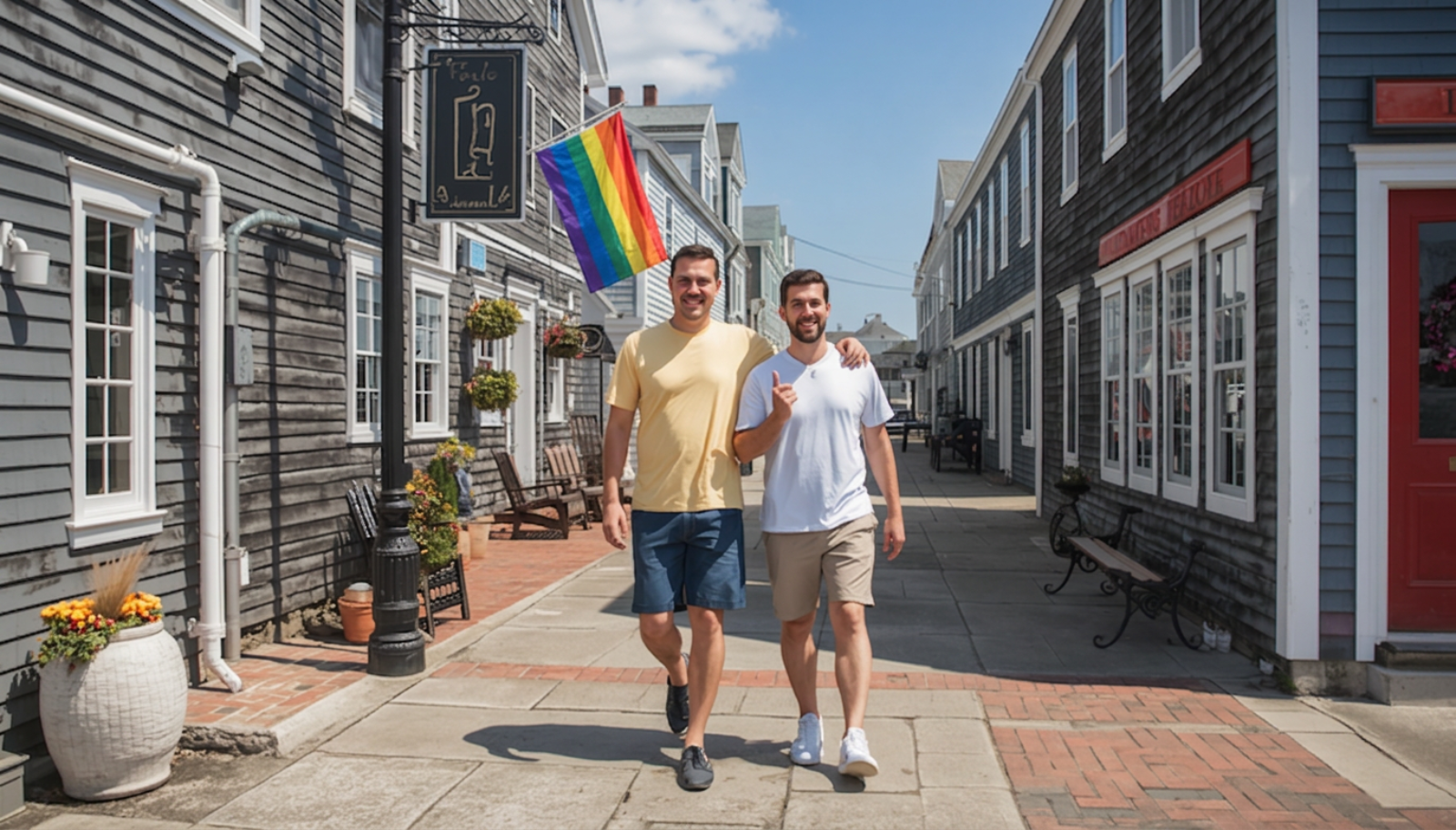
There are places that welcome gay travelers, and then there is Provincetown. The difference is not a matter of degree, it is a matter of history, identity, and something that feels almost impossible to manufacture no matter how hard a destination tries. Provincetown was not made gay-friendly by a tourism board or a diversity initiative. It was built, slowly and stubbornly, by artists, fishermen, drag queens, activists, writers, and a community that chose to exist loudly at the very tip of Cape Cod, on a narrow spit of land where the Atlantic pushes the continent to its absolute limit. That geographic extremity has always been part of the magic. When you are as far east as you can go without falling into the ocean, the rules of the mainland start to feel a little less binding.
P-town, as anyone who has been calls it, operates on its own time and its own terms. The permanent population hovers around three thousand people year-round, a tight-knit, fiercely independent community where everybody eventually knows everybody. Then summer arrives, and the town transforms almost overnight into something else entirely: sixty thousand people crammed onto Commercial Street at golden hour, the smell of lobster rolls and sunscreen mixing with the salt air coming off the harbor, drag queens doing their makeup in windows open to the street, and that particular energy of a place where, for once, the gay experience is not the exception but the norm. If you have spent most of your life in places where holding hands required a quick scan of the room first, arriving in Provincetown for the first time can feel genuinely disorienting, not because anything is wrong, but because something is finally right.
Why Provincetown Is Unlike Any Other Gay Destination in America
The comparison that gets made most often is to Fire Island or Key West, and while all three share a kind of permission-to-exhale quality, Provincetown has something the others do not quite replicate. It has depth. The Fine Arts Work Center has been here since 1968, drawing serious writers and visual artists to residencies that shaped American culture. Tennessee Williams summered here. Norman Mailer lived here for decades. Mark Doty wrote some of the most important gay poetry of the AIDS era while watching the light fall over the harbor. That artistic seriousness runs underneath everything, it is why the galleries on the East End are genuinely worth visiting, why the conversations you have at the bar can turn unexpectedly brilliant, and why the town has always managed to hold together a community that runs from retired schoolteachers to circuit party veterans without feeling incoherent.
The Portuguese heritage matters too, and it is easy to miss if you are only here for the scene. The fishing families who settled Cape Cod in the late 19th century left something in the architecture, in the bakeries still selling malasadas on Commercial Street, in the names on the storefronts and the boats. Provincetown is not a resort that was dropped into a generic coastal town. It grew out of a specific place with a specific history, and the gay community that claimed it did not erase that history, it layered itself on top of it in a way that, somehow, works. That layering is part of why the town feels so textured compared to destinations that were essentially purpose-built for tourism.
Massachusetts was also the first state in the country to legalize same-sex marriage, in 2004, and Provincetown was already decades ahead of that moment. Gay couples were building lives and raising families here long before the law caught up. When you walk past the guesthouses on the West End, past the rainbow flags that are not seasonal decorations but permanent statements, you are in a place where the culture of full legal and social equality for LGBTQ+ people is simply the air everyone breathes. That history is not just sentimental. It is part of why Provincetown continues to draw people who want to experience what that actually feels like on a daily basis, not just on Pride weekend.
The Rhythm of Provincetown: What a Day Actually Looks Like
Understanding how Provincetown works requires understanding Tea Dance, because Tea Dance is not just a party, it is the organizing principle of the P-town afternoon. Every day in season, from roughly 4 to 7 p.m., the Boatslip Beach Club hosts an outdoor dance party on its deck overlooking the harbor that has been running for decades and has taken on the quality of ritual. The crowd is mixed (gay men, lesbians, trans people, their straight friends who drove up from Boston and fell in love with the vibe) and the music hits the specific frequency that makes you want to stay for one more drink even when you said you were leaving. After Tea Dance, the crowd disperses slowly down Commercial Street, warming up for whatever comes next, and the town enters that particular hour of the early evening when everyone is sun-flushed and slightly giddy and anything feels possible.
Commercial Street itself is worth arriving in Provincetown just to experience. It runs the full length of the town (three miles of gallery, restaurant, guesthouse, bar, boutique, and pure spectacle) and it is not navigable by car in summer, which means the whole thing becomes one long pedestrian corridor where the pace is set by whoever is in front of you. The East End is quieter, more residential, where the serious artists have their studios and the landscape starts to open up toward the dunes. Walk west and the energy gets louder, the Crown & Anchor complex, which contains more entertainment than most small cities manage, sits on Commercial and has been the beating heart of the nightlife here for generations. The Atlantic House, known to everyone as the A-House, is a short walk away. Established in the early 20th century and gay-friendly since before that phrase existed, it claims the title of the oldest continuously operating gay bar in America with some justification. Walking in feels like walking into something that matters.
Late at night, when the bars begin to push toward closing, the town reconvenes at Spiritus Pizza on Commercial Street, where the 2 a.m. crowd (still dancing, still laughing, shoes in hand) lines up for slices and continues conversations that started hours earlier in any of a dozen different venues. Spiritus at 2 a.m. is one of those specifically Provincetown things that you cannot quite explain to someone who has not experienced it. It is a pizza place that functions as the epilogue to an entire evening of community.
Where to Stay: Gay Guesthouses and LGBTQ+ Hotels in Provincetown
Provincetown's accommodation scene is dominated by guesthouses rather than hotels in the conventional sense, and that is precisely what makes it special. These are mostly intimate, independently owned properties, many of them historic homes converted into places to stay, with owners who have lived here for years and can tell you which drag show to catch on which night and why you should walk Bradford Street instead of Commercial Street at least once to see the town at a slower pace. The guesthouse culture is central to the P-town experience. This is not a Marriott destination. It is a place where the person at the front desk knows the bartender at the A-House and will call ahead if you are running late for Tea Dance.
The range of options within the LGBTQ+ accommodation world here is broader than most people expect. The Brass Key Guesthouse, set in a cluster of historic buildings near the West End, represents the upscale end of the Provincetown guesthouse spectrum, adults-only, beautifully maintained, with a heated pool and a level of quiet that is harder to find in the summer crowds of Commercial Street. It is the kind of place where you have a proper breakfast and then spend the morning reading before the afternoon heat pulls you toward the beach. Land's End Inn sits above the town on a hillside with views that make it immediately clear why writers and painters have been coming to this exact place for a century, the light on the harbor from that elevation has a quality that is genuinely difficult to describe without sounding theatrical. The Brassewood Inn brings a more laid-back energy, with individually designed rooms in a Victorian property where the front porch is a legitimate social space on summer evenings.
For men traveling together or solo men looking for that specific experience of a space that is intentionally, comfortably, entirely their own, several properties in Provincetown operate as men-only guesthouses. These are not spaces defined by exclusion so much as by a kind of deliberate ease, the ease of not having to navigate who you are or what you want or whether the person at the pool is going to be weird about it. They attract a mix of regular visitors who have been coming to the same property for twenty years and first-timers who discover the peculiar pleasure of sitting at breakfast with strangers who are, in some meaningful sense, your people. The social life that emerges in these spaces is genuinely one of the underrated pleasures of P-town travel, and it is worth seeking out even if you have never traveled this way before.
When thinking about location, the choice between the West End and the East End matters more than it might seem. The West End puts you closest to the nightlife, the Crown & Anchor, the Boatslip for Tea Dance, and the specific density of bars and people that defines the Provincetown summer social scene. The East End is quieter, more beautiful in a landscape sense, with easier access to the beach and a pace that allows you to remember why Cape Cod exists beyond the parties. Neither is wrong. They are just different versions of the same destination.
-> Check all gay hotels in Provincetown here
Tea Dance, Nightlife, and the Art of the Provincetown Evening
The Provincetown nightlife operates in a way that rewards patience. There is no single place where everything happens, and part of the pleasure of the evening is the movement between venues, a drink at the Governor Bradford, which is the kind of bar where locals outnumber tourists on weeknights and pool is played seriously, then a drift toward the Crown & Anchor complex for whichever of its multiple spaces fits your mood that evening. The Crown is genuinely impressive in scale for a town this size: it holds a cabaret room, a leather bar, a piano lounge, a disco, and a theater space where drag productions run at a quality level that would not embarrass off-Broadway. Catching a show at the Crown during peak season requires advance tickets and some planning, but it is one of those specifically Provincetown experiences that lodges in your memory.
The A-House plays a different role. It is dark, unpretentious, and old in the way that only genuinely historic places are old, not renovated to look vintage, but actually worn in by decades of the same rituals. The back bar area is where the dancing happens; the front room is for people who want to talk. On the right night, it buzzes with an energy that connects to something much longer than your particular vacation.
What makes the Provincetown nightlife distinctive is not any individual venue but the way the street functions as connective tissue between all of them. Commercial Street in summer is itself a social space, people stopping to talk, groups forming and dissolving, someone you met at Tea Dance appearing again at midnight in completely different context. The town is small enough that this happens constantly, which gives the evening a sense of continuity that larger cities with their dispersed neighborhoods cannot replicate. You are, in the best possible sense, stuck with everyone else in Provincetown. And everyone else is generally excellent company.
The Weeks That Define Provincetown: When to Go and Why It Matters
The Provincetown calendar is structured around a series of themed weeks that have become events in their own right, drawing specific communities from across the country and, increasingly, internationally. Carnival Week in August is the largest and most extravagant, with a parade that transforms Commercial Street into a costume competition of genuinely impressive scale and a week of parties that culminates in something closer to a festival than a vacation. It is chaotic, joyful, expensive if you have not booked far in advance, and completely worth doing at least once. Bear Week, which falls in July, brings a specific community to Provincetown with its own social culture, its own events, and a particular warmth that the week tends to generate. Women's Week in October arrives after the main summer rush has subsided, when the town is slightly quieter and the light has shifted from the harsh brightness of August to something more autumnal and forgiving. The Provincetown International Film Festival in June opens the season with a strong cultural note, drawing a crowd that wants something beyond the party.
If you are visiting for the first time and want to experience the full density of the Provincetown social scene, Carnival or Bear Week is your entry point. If you want to experience what the town actually feels like as a community (the Provincetown that locals love, the one that functions year-round) September and October offer a version of the destination that most summer visitors never see. The guesthouses are quieter, the restaurants can get you a table, and the conversations with the people who actually live here are easier to have. Both versions are real. Both are worth knowing.
Beyond the Scene: The Provincetown That Most Visitors Miss
Herring Cove Beach sits at the western end of the Cape Cod National Seashore, a short bike ride from most guesthouses, and it is where the gay section of the beach has been established by informal consensus for long enough that it now simply is. The National Park Service maintains the beach; the community maintains the culture of it. On a calm summer afternoon, with the right light, it is one of the more beautiful stretches of Atlantic coastline you will find in the northeast, and the social dynamic of the beach (relaxed, inclusive, low-stakes) mirrors what Provincetown does best. Race Point Beach, a little further around the tip, is wilder, less crowded, and backed by dunes that have a severity to them that makes the beach feel genuinely remote even though you can cycle there in twenty minutes.
The dune shacks of the Peaked Hill Bars Historic District (a handful of primitive shelters in the national seashore with no electricity or running water, used since the early 20th century by artists on residency) represent a version of Cape Cod that is genuinely unmediated. Eugene O'Neill wrote here. Jackson Pollock stayed here. Whether or not you apply to rent one, knowing they are out there, behind the dunes, is part of understanding what Provincetown actually is at its core: a place that has always attracted people serious about the project of living differently.
The Pilgrim Monument on the hill above town is worth the climb for the view alone, from the top, the full geography of the Cape becomes comprehensible in a way it is not at street level, and the harbor takes on a scale that explains why this particular place attracted everyone from the Pilgrims in 1620 to the fishing families of the Azores a century later. The monument's museum is small but genuinely informative about the Wampanoag people and the early colonial history of the Cape.
Getting to Provincetown and What You Need to Know
The fast ferry from Boston is the best introduction to Provincetown that exists. Bay State Cruise Company and Boston Harbor Cruises both operate high-speed services from the Seaport that put you in P-town in ninety minutes, arriving by boat, watching the harbor approach, with the Pilgrim Monument on the hill and the town spread below it, is a specifically good way to arrive. The slower ferry from Plymouth is longer but offers a different scenic experience. If you are driving, the approach on Route 6 through the National Seashore is beautiful and slightly otherworldly, the dunes replace the trees as you get further into the Cape, and the landscape becomes stark and open in a way that prepares you, almost ceremonially, for the town at the end.
A car is not necessary in Provincetown and is, in summer, actively inconvenient. The town is walkable and very bikeable, several rental outfits on Bradford Street and Commercial Street will get you set up within minutes. Parking is expensive and frustrating during peak weeks, and most guesthouses will tell you the same thing: leave the car, rent a bike, walk everywhere. The town is designed for this. It has been designed for this for most of its existence.
Frequently Asked Questions
Is Provincetown really as gay-friendly as people say?
Yes, and it goes further than most places. Provincetown is not simply tolerant of LGBTQ+ visitors, it has been shaped by and for the LGBTQ+ community for decades. Gay and lesbian couples, trans people, and queer travelers of all kinds will find a place where they are not the exception to the rule but the rule itself. The town's culture, its businesses, its events, and its social life are oriented around LGBTQ+ experience in a way that is genuinely rare.
When is the best time to visit Provincetown?
It depends on what you want from the trip. For maximum energy and the full density of the scene, Carnival Week in August or Bear Week in July. For a more relaxed visit with strong social culture and beautiful light, September or early October. For the film festival and an opening-of-season energy, June. The shoulder seasons (May and October) offer the guesthouses and restaurants at lower prices and the town at a more residential pace that has its own appeal.
What kind of gay guesthouses are available in Provincetown?
The range is wider than most people expect. There are upscale, adults-only guesthouses with pools and premium amenities, intimate historic properties with strong personal character, men-only guesthouses with a specific community feel, and boutique-style properties that split the difference. Almost all are independently owned, which means the service tends to be personal and informed rather than standardized. Booking well in advance (especially for themed weeks) is essential.
How do I get from Boston to Provincetown?
The most enjoyable option is the fast ferry, operated by Bay State Cruise Company or Boston Harbor Cruises, which takes approximately ninety minutes from the Seaport. Driving takes between two and three hours depending on traffic and the time of day. Most visitors from Boston choose the ferry.
Is Provincetown safe for LGBTQ+ travelers?
Provincetown is one of the safest destinations in the country for LGBTQ+ travelers, full stop. Same-sex marriage has been legal in Massachusetts since 2004, and Provincetown has been an openly gay community for decades before that. Public displays of affection between same-sex couples are completely normal. The town's entire social infrastructure is built around LGBTQ+ life and comfort.
Is Provincetown good for gay solo travelers?
Provincetown is excellent for solo travel. The guesthouse culture creates natural social opportunities, breakfast tables, pool decks, and common spaces where meeting people happens organically. The bar and beach scene is equally welcoming to solo visitors, and the men-only guesthouses in particular tend to foster a strong sense of community among their guests. Coming alone and leaving with friends is a very standard Provincetown experience.
By Xavier B
in
Pronvincetown
,
Destination
,
Hotels
tuesday 12 may 2026
Previous post
Gay Saunas in New York City
Discover gay saunas in New York City: bathhouses, cruising culture and LGBTQ wellness spaces in NYC.
By Xavier B
in
Destination
,
New York
thursday 23 april 2026
Next post
Gay Hotels in Palm Springs, CA Desert Heat, Poolside Freedom, and the Most LGBTQ+ City in America
alm Springs is America's gay desert capital midcentury architecture, clothing-optional pools, Arenas Road at midnight, and a community so embedded it helped elect the country's first openly gay mayor. Find the best gay hotels and guesthouses in Palm Springs
By Xavier B
in
Destination
,
Palm spring
tuesday 12 may 2026